
A Different Kind Of Tide

crop.php.jpeg
zedge.net


Ok, this image may be a little deceiving. If you haven’t guessed already, I’m going to write a little about tidal heating. Tidal heating has nothing to do with making the tides on Earth catch on fire, I just thought that was a beautiful image and it made for a good pun.

Tidal heating is best seen in Jupiter’s moon Io. Scientists wondered how the moon could have such active volcanic activity given its size, and tidal heating is the explanation. Much like Earth and our moon, The Moon, interact with tidal forces, Io and Jupiter do as well. However, Jupiter is much larger than Earth, and Io’s orbit is also highly elliptical due to gravitation force interactions from Jupiter’s other moons and Io. These factors together mean that Io experiences an extremely large amount of varying tidal squeezes from Jupiter as it goes through its orbit around Jupiter.

“The Cosmic Perspective” by Jeffrey O. Bennett, Megan O. Donahue, Nicholas Schneider, and Mark Voit uses a great analogy of Silly Putty being squeezed, the more it is squeezed into different shapes it heats up and becomes more malleable. The same goes for Io, except the added heat leads to volcanism. (Good thing that doesn’t happen with Silly Putty!) The forces acting on Io cause friction in the world leading to over 200 times as much heat generated as from the radioactive heat on Earth.
 

“Current” Events on Tides

Saltstraumenvideoblocks-whirlpools-of-the-maelstrom-of-saltstraumen-nordland-norway_hrqs7gkbw_thumbnail-full01.pngVideo Blocks

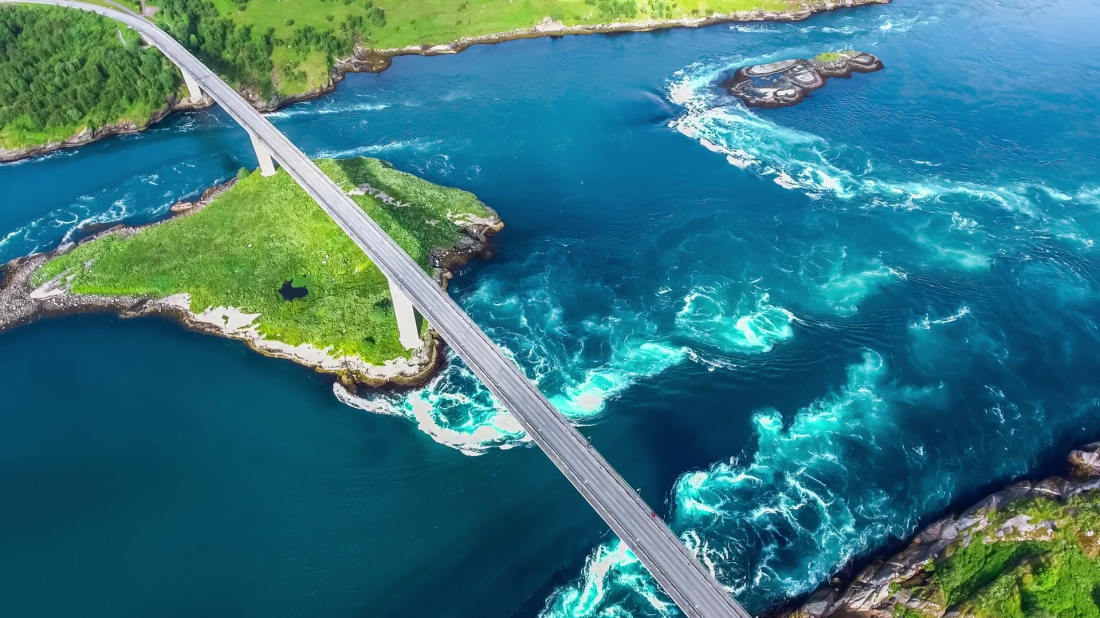
The strait at Saltstraumen is one of the most interesting straits on the planet, and it has to do with more than just its notable beauty. Saltstraumen is the location of one of the strongest tidal currents in the world. When the tides come in and out from the large bodies of water on either side of the strait, the water is confined to a much smaller space in the strait and rushes through at speeds up to 7 knots on inflow, and 8 knots on outflow. With water speeds like this, whirlpools form in the strait that can reach up to 10 meters in diameter. The water isn’t always rushing though. Since the tide comes in and then out, there is a point where the water is somewhat calm and crossable while everything is “turning around”. As the Earth spins, the sides closest and furthest from the Moon will experience high tide, and the perpendicular sides will be at low tide. So while the location is transitioning from being in a high tide orientation to a low tide orientation there is a time when the water is no longer being moved by the tidal force.

The Dark Side of the Moon

Source: Wikipedia

Besides a popular Pink Floyd album, what is “the dark side of the Moon”? Most people have not given much though to what it means or how it got its infamous name. For me the first image I get is of the moon I know and love turning over to the dark side of the force, much like Anakin from Star Wars when he becomes Darth Vader. In reality, however, there are no red lightsabers or Sith involved, just science…

The dark side of the Moon is a somewhat misleading name because it may lead a newbie astronomer to believe that the dark side of the Moon never actually has any sunlight touch it. It’s not a stretch to assume that the dark side would always be dark. What the dark side really is though, is the side of the moon that never reflects any light towards Earth. An observer from Earth can never see the dark side of the Moon, a more accurate name for the dark side of the Moon is “the far side of the Moon”. The far side of the Moon is the side of the Moon facing away from earth. The meaning of dark in the earlier name refers to the unseen or unknown nature of the side, rather than the absence of light on that side.

“But wait,” a newbie astronomer might ask, “since the Earth is constantly rotating, and the Moon is constantly orbiting the Earth, wouldn’t an observer from Earth eventually see all sides of the Moon?”

A person with this questions asks so rightly, but they are unaware that the moon is in synchronous rotation with the Earth. That means that the Moon spins on its axis at the same rate that is orbits the Earth. As the Moon orbits the Earth, it spins at just the right rate so that the same side of the Moon is always pointing towards Earth. It may seem like a phenomenal coincidence, but many moons that orbit close to their planet like ours are locked into synchronous orbits as well.